Sunday, February 17, 2008

Oh yeah, I have a book blog...

Leave it to Margaret Atwood to totally annihilate my momentum. This is the third Atwood book I've started and attempted to muddle through and I guess I am just a bad feminist reader because damn if her books don't make me want to rip my hair out. It's her bizarre mixture of science-fiction futuristic societies blended with endless descriptions of frail, powdery, paper-thin old lady skin that makes me want to gouge my eyes out.

So I put The Blind Assassin down and have been pouting ever since. I hate not finishing a book. I've done a ton of first-page hopping in the past month because when I give up on a book, I become ravenous for others, but I can't commit to any.

It's seriously like getting over a failed relationship for me. After ditching a book I really had hoped would be a great read for me, I flit from one book to another, reading a page or two to see if it will appease me (generally fluffy chick lit in this situation) in my disappointed state. This time, though, I attempted to flit from Booker winner to Booker winner and that is just a brain-fuck; too deep, too intense, too demanding when I'm simply looking for a rebound from a bad read.


I've finally settled on Ami McKay's The Birth House, which is essentially the story of a midwife-in-training dealing with the infiltration of modern medicine and a male obstetrician in her domain.

It is a wonderful mix of a girly drama and historical fiction. Thus far I am enjoying it immensely, as it's feeding my "rebound" need as well as offering some actual literary quality, as opposed to my usual Bridget Jones-y type selections when in this frame of mind.

I have many thoughts on the book itself and the topic it covers, but I think I'll save it until I'm farther into the book.

Saturday, January 19, 2008

Booker #3: The Blind Assassin, Margaret Atwood


Sigh. I am not nearly the sophisticated reader I once was. I've never really been able to enjoy Atwood (probably because the movie version of The Handmaid's Tale freaked me out to no end and I could never get past that), but I am really trying here. It starts with the main character describing her sister's death (an apparently suicidal joy ride off the side of a bridge) and the novel the sister has left behind, which she posthumously publishes.

So far the book is a surreal combination of this novel within a novel and a smattering of newspaper clippings of obituaries also pertinent to this main character's life. The obituaries are quite interesting; the novel within a novel? Well, it's a weird mixture of a torrid love affair and a freaky sci-fi, otherworld where horrible social conditions drive people to heinous crimes, apparently.

It is a looooong read and fairly slow, so I wouldn't expect to hear from me here anytime in the next week or so. I hope to get through it because I really feel like at 36 years old, I really should be able to say I've read at least one Atwood novel. Sigh.

Wednesday, January 16, 2008

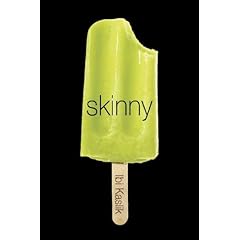
Slim Pickin': Skinny, Ibi Kaslik

I was drawn to this book because, as a chubby girl, eating disorders have always fascinated me in a twisted kind of way. The book is the story about a perfectionist medical student with daddy issues (shockingly, she's the one with the eating disorder) and her younger, athletic, academically-apathetic sister, who magically has the perfect relationship with the daddy in question.

It's not a bad book; it's actually listed for many Canadian book awards, from what the back of the cover says. Eh. I didn't really see anything award-worthy, although the final pages give themselves over to a poetic tone that is far lovelier than anything else in the book.

The book, in my opinion, tries to do too much. It's narrated in alternating chapters by the two sisters, which can be wonderful (think Joy Luck Club), but here it just takes away from the older sister, Giselle's, story because she is, after all, the main character. Holly, the younger of the two, just kind of lets us know about how her sister's problems are wreaking havoc on her life and oh, yeah, the ghosts. She sees ghosts. That part is never entirely fleshed out.

Neither is the boyfriend, really. I never quite understand his motivation for his feelings for the girls and I didn't really find him necessary to the plot.

I wanted something, if you'll pardon the term, meatier. I wanted to learn more about anorexia and the mindset that goes along with it. I already know about perfectionism and daddy issues. I wanted it to go deeper; for the character to come more to life for me. Perhaps only because Giselle's chapters were constantly interrupted by her sister's, I never felt connected to her or the story.

I guess it's from having picked this book up randomly after having poured myself into two Booker Award winners; this book isn't bad at all. It's a good read. But it's not Enright or Doyle and I couldn't help but hold that against it while I was reading.

Saturday, January 12, 2008

Sob-Fest

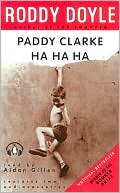
Yeah, Paddy Clarke Ha Ha Ha broke my heart. I had forgotten the ending and even when I knew what was going to happen, when it it finally did, I was sad beyond words.

There is little in this world as tragic as a child's mind trying to grapple with adult issues and adult relationships, struggling to make sense of the angry words that fly across the dinner table, above his head. Childhood's innocence is fragile as an egg, and this kid's innocence is just cracked all to hell, way before it's time. The conflict in his mind and heart as to whose "fault" it all is and how can he lay blame on the two people he loves the most, is just wrenching.

Saturday, January 5, 2008

Booker #2: Paddy Clarke Ha Ha Ha, Roddy Doyle


I read this book a decade or so ago, but I swear I remember nothing of it save that I liked it and I vaguely feel like it made me cry.

I have to say, it's like Lord of the Flies and "A Christmas Story" rolled into one thus far. The story of Patrick Clarke and his little brother, Sinbad, and all their friends in this seemingly down-trodden Irish town slowing being taken over by the Corporation, is rife with random acts of compulsive violence and "triple dog dare you"'s that make the mother in me cringe. At the same time, the armchair therapist in me is trying to figure out where their pent-up, seeping rage comes from that they feel the need to constantly beat the snot out of each other for a laugh.

It's actually not hard to figure out, come to think of it. There are a bevy of reasons these young boys would feel and then bury their angst, given the circumstances of their lives.

A couple hundred pages to go and, like I said, I am fairly certain this one's going to make me full-on cry like a little girl.

Wednesday, January 2, 2008

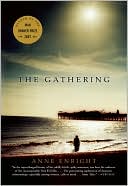
The Gathering, Anne Enright--Booker Prize winner 2007


Wow. What started as a vaguely ethereal, esoteric rambling about an invisible mother, turned into one of the most brutally painful and beautifully written stories of loss and hoped-for redemption I've ever read.

The main character, Veronica, spends a lot of time musing about her family; its past, in part how she imagines it and in part how she remembers it, and it's present, as she feels it. Her "Irish twin" brother has passed away and as the family gathers to mourn (whether it's real grief or obligatory in nature), she is forced to face a gut-wrenching memory that clarifies for her everything that has ever seemed "off" about the people she loves, including herself.

I really didn't expect to like it. It had a Virginia Woolf-eque stream of consciousness initially that has always turned me off. I am fascinated by the life of Woolf; I love the idea of Woolf, but not so much the words of Woolf. So I expected to have to trudge my way through this, semi-congratulating myself all the way for being a reader of such lofty and ambitious literature. But by page 100 or so, I was finding myself wishing for a spare minute in the day so I could steal a few pages, dying to know what happens next; not so much in an action driven sort of way, but in the sense that I just loved this narrator, was broken hearted for her, and wanted to spend a few more minutes with her.

I was satisfied when it was over, but truly wanted to know what happened next. I spent some time envisioning what would happen after the closing pages, had Enright chosen to take her story into the next chapter of this woman's (and her family's) life. This is one that will resonate with me for quite some time.

Sunday, December 23, 2007

Done with Little Children

Loved this book. I loved that each character was so very flawed and almost equally likable and dislikable at the same time. Where Desperate Housewives is over the top and American Beauty is miserably tragic, Little Children falls somewhere in the middle--realistic in it's angst, not expecting the reader to swallow massive amounts of tragedy, but not letting them off at the end with a shiny, happy ending, either. Perrotta definitely takes a big old dump on the idea of domestic bliss, no question, but it's not like the universe is out to get these people--they walk into their messes, eyes wide open and for no other reason than they want to. They are the "little children", acting on impulse on doing what satisfies the immediate need or want in them, not considering consequences until the final chapter.

Overall, it was a super easy and captivating read; I wish the characters HAD felt a bit more moral fretting over the situations they threw themselves into, but that would have defeated the metaphor of their childlike (or would "childish" be more appropriate) behavior. I did appreciate the allusion to Flaubert's Bovary that kept me wondering how the lives of these people would parallel that particular character's conflict and demise. While nothing quite as gruesome and dramatic as drinking arsenic, I can definitely see why Perrotta chose that classic as the reading group's literary selection. I think he could have also alluded to any of Austen's classics, as Perrotta is clearly poking fun at our society with the same satirical wink as Austen did in her time.

I'm off to read my first Booker Prize winner: The Gathering, by Anne Enright. I started it moments after completing Little Children and it is like jumping into the deep end of a cold pool in comparison to Perrotta's writing. Very stream-of-conscious-y and abstract-dreamy like. But I am already in love with the narrator Veronica and the way she paints the world around her with her poetic choice of words and the clearly complex relationships she is going to share with me. Can't wait to curl up tonight and see what happens next.