Do you read any author’s blogs? If so, are you looking for information on their next project? On the author personally? Something else?
I read a few authors' blogs--Stephanie Taylor Wilder's "Baby on Bored", who wrote Sippy Cups are Not Far Chardonnay and Naptime is the New Happy Hour. I started reading Stephanie's blog actually before her books--I was on 14 long weeks of bedrest during my pregnancy w/ Ethan and I found Stephanie's blog through someone else's. I had no idea she was a published author, but she made me laugh so hard I almost peed (admittedly not difficult in the middle of the 2nd trimester). She has a wry, sarcastic, sometimes painfully honest perspective on parenting and her voice is so familiar and comfortable, the blog is one of my favorites.
I also read Jennifer Lancaster's (Bitter is the New Black, Such a Pretty Fat, Bright Lights Big Ass) blog, "Jennsylvania". She's ridiculously hilarious.
I've also read, but don't religiously follow, the blogs of both Stephanie Klein (Straight Up and Dirty, Moose: A Memoir of Fat Camp), and Jess Riley (Driving Sideways).
I rarely look for information on their latest books; I'm far more interested in their stories and just hearing their voices (I'm in it for the comedy, mostly).
Thursday, February 12, 2009

Tuesday, February 10, 2009
Tuesday Teaser: Moloka'i
The explanation for Tuesday Teaser can be found by clicking on the "Tuesday Teaser" icon on the left side of my blog.
I'm currently reading Moloka'i, by Alan Brennert
Anger and doubt erupted again like lava, emotions entirely inappropriate for this place, this act. She sprang to her feet and bolted from the chapel, startling a sister about to enter, and retreated to the safety of her room. There she fell again to her knees, knitting her hands together in a tortured mimicry of prayer. Whenever she felt the anger bubbling up she would stop, take a few minutes to compose herself, then start again; but though the anger slowly cooled she found that oozing up between the words of contrition and adoration was a troubling fear. Fear of herself and what she was capable of, what she had done to that little girl; and fear that perhaps Sister victor was right, that contagion was all around them.
Just have to add, I am LOVING this book. Loving. More later.
Saturday, February 7, 2009
The Reader, Bernhard Schlink
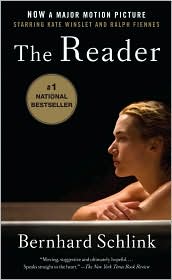
I had hoped to love this book more than I did. I could never quite fall into step with the narrator's voice or feel much for either Michael or Hanna. There was such a stoicism in how Michael told the story of their affair and of Hanna's trial later on, it was almost impossible to rouse any emotion or empathy for them. Am I the only one?
I did find Hanna's conflict interesting--that she'd choose to take the blame for such egregious crimes over admitting to the degree to which she lacks education. It seemed like such a counter-intuitive thing to do; I'm still not entirely sure I understand why she makes the choice she does---is it pride or guilt? Does she feel that she deserves the harshest punishment even though she is not the one who masterminded the crime? Is the austerity with which she lives her life and pushes people from her done out of a sense of penance or arrogance?
I'd like to believe she lives her life and makes the choices she does as a form of atonement, but it's never entirely clear--she is so devoid of emotion for so much of the story, and given her crime, it's hard to give her the benefit of the doubt. There's only so much sympathy one can drum up for a Nazi, you know?
Monday, February 2, 2009
Away, Amy Bloom

Well, maybe not "lighter", but at least this story goes a long way in restoring my faith in the strength of the human spirit.
Lillian Leyb comes to America after her family is viciously murdered in pogrom in Russia, a scene which plays out over and over in her mind in vivid and frightening detail throughout the book. She flees to a life in New York's Yiddish theater district, becoming mistress to both a theater owner and his son, while trying to put the memories of the past behind her. Until.
She learned that possibly, possibly, her daughter survived the pogrom and is currently living in Siberia with a family who rescued her. Without hesitation, Lillian leaves New York City and sets out across the country, from New York to Seattle to Alaska and to the Bering Strait. The intensity with which she strives towards this goal is heart-rending. Any parent wants to believe they'd do the same; under-take any obstacle or trial of strength and perseverance. But to travel in a railroad car broom closet, psyche out pimps and prostitutes, walk from Alaska to Russia (yes, I know Sarah Palin can see Russia from her house, but still), with only the faintest hope of making the trip in one piece and with no set information about where to find your child? In Siberia?
The book falls short of being epic only because it's just too short. I wanted the book to be 500+ pages; I wanted there to be detail, more character development, more everything. I wanted more of Lillian's history, more scenes going across the country, more interactions with other characters.
My favorite part of the book, aside from Lillian herself and her fierce determination, was the way Bloom provides an epilogue for each character Lillian encounters, after she leaves them. As though their lives, after being touched by her, are set on a certain path and Bloom must let you know what comes of them, even though Lillian never will. It was brilliant and it made each character seem so much more real than they would have if they'd simply ceased to exist in the book's world once Lillian moved on.
So not really the "light" book I said I was going to read (I started Jon Stewart's Naked Pictures of Famous People, but wasn't really feeling it), but it was well worth the emotional energy I spent on it.
Tuesday, January 27, 2009
Revolutionary Road, Richard Yates
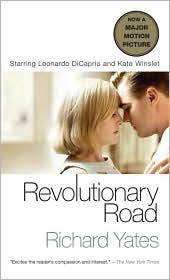
Oh. My. God. I knew from the movie previews to expect suburban malaise. However. This book is suburbian malaise and existential angst hooked up to a car battery and high on crack.
Frank and Alice Wheeler are a couple of married suburbanites, stuck in the stereotypical, Leave-It-To-Beaver 1950's; or rather, right on the outside of it, as their home is adjacent to, but not actually IN the new Revolutionary Estates development with it it's homes and cars looking "like candy and ice cream". Each fancies themselves to be more interesting and passionate than the rest of those suburbanite couples, tucked in their perfect little homes with their perfect little lives. They scoff at those content with the mediocrity of life in the suburbs and compliment themselves on being oh, so much more interesting.
It was interesting to me that the first major action of the book is that of a play being put on by a small local theater group. As the play goes, in terms of it's success, so, in a way, does the story of Frank and Alice go. They are, in fact, living a lie, a sort of play within a play that they seem desperate to break out of. There are moments of shining hope and so-close-you-can-taste-it triumphs over their lives. And there are also crashing failures and upsets, until they reach, as individuals, and a couple, their ultimate breaking points.
As we learn about each character's childhood (the author seems fascinated with the idea of psycho-analysis; there is even mention of Freud's theory of penis-envy), we begin to understand what motivates them and why they are driven to be the superbly flawed and, at times, all but unlikeable characters that they are.
The beauty of this book is the characters around Frank and Alice. The meddling, nervous real estate broker and her half-deaf (and grateful for it) husband, Helen and Howard Givings--who Frank and Alice will be if they don't bust out of this rut and strive for the greatness they feel they are capable of. Their neighbors, the Campbells, who have settled into their malaise rather than struggling against it. And perhaps most interesting, the institutionalized son of the Givingses', John, who is the only character who seems to "get" Frank and Alice.
The book starts with a quote from John Keats that is as follows: "Alas! When passion is both meek and mild." Alice and Frank are each both of these things, in turns. They're strengths and weaknesses yo-yo throughout the story, but never find a middle ground, never find one another.
I expected pages of bitter disagreement and domestic strife in the book; I've seen the advertisements for the movie in recent weeks. What I didn't expect was to see the absolute and utter dissolution of the American Dream unfold before my eyes over the past two days. I could not sleep after turning the last page. While I cannot relate in any really authentic way to either Frank or Alice, in experience or sentiment, I could not help but be shaken all the way down to a very deep place in myself when I realized that there are people out there who can, and do, relate. Much in the same way as I did after seeing the film "American Beauty" years ago, I walked around today, watching couples and looking at houses in my neighborhood and wondering, "Who are they really, and what is the true substance of their lives and their relationship?"
Next, I'll be reading something a bit more light-hearted. My brain and heart need a break after this one.
Sunday, January 25, 2009
Snow Flower and the Secret Fan, Lisa See

So fine; I gave up on War and Peace for the time being. There are too many books out there begging to be read for me to give up precious time slaving over a horrible translation of what I'm sure is a spectacular book, but which at this point, has no chance in hell of being remotely appreciated by me. So I will go back to it. Sometime. Maybe.
Instead, I spent part of my Barnes and Noble gift card (which I sadly burned through like it was a stick of butter set on top of a blazing oven) on Lisa See's Snow Flower and the Secret Fan. What a beautiful book. It is the story of Lily, who at the age of 80, an age few women in 19th-century China would have lived to see, looks back on her life and tells us of her greatest love and of her greatest sin.
The book's focus, a friendship between two women, was riveting and heart-rending. Paired as "laotongs", or, "Old Sames" (essentially soul mates) as children, Lily and Snow Flower forge a bond from their foot-binding days of girlhood until their last breaths. The contract of the laotongs transcends all other contracts and is unbreakable. Set against the backdrop of strict social customs, changing fortunes, arranged marriages, and the trials and triumphs of motherhood in a time and place where only boy babies counted, Lily and Snow Flower are each other's sources of strength and comfort. When separated, they communicate through "nu shu", or "women's writing", carefully inscribed on a silk fan.
The intricacies of social custom, and the stoicism with which women were expected to bear the inevitable circumstances of their lives made the book all the more heart-breaking. The process of foot-binding andmatch-making, and rituals of singing laments and well-wishes to the bride before she leaves her "natal" home for that of her husband's--all of these elements of the life of a Hunan woman at this time were described in such lyrical detail that the modern reader is both horrified and awed.
It isn't all beauty and loving commitment between Lily and Snow Flower, however. Their contract is threatened through the misunderstanding of a message written onto the secret fan. The irony that in a story based around the written communication between these two women, that it should be their "nu shu" messages that lead their friendship into peril was fascinating.
I've always found the dynamics of the friendships of women to be at least as interesting, if not more, than that of the relationships between men and women. Raised to be companions and competition, the potential for fiercely devoted love and bitter rivalry and jealousy is so much stronger than that between members of the opposite sex. Also, having always believed that a woman is far more likely to find her soul's true mate in a female friend rather than a boyfriend or husband, this book spoke to me of the immense power of friendship and the need to always keep your girlfriends close to your heart and mind, regardless of life's circumstances.
Next up: Revolutionary Road. I can't bring myself to spend a date night with Husband watching Leo and Kate tear it up as a miserable married couple, so I'm going to read the book instead.
Sunday, January 11, 2009
I Must Confess...
I am hating War & Peace.
It is so convoluted and the whole thing feels more like an endeavor in keeping track of names and making sense of the awkward language of what I have to assume is a lousy translation.
I'm only 200 pages in, more than two weeks after starting it; it's frustrating for me to not be able to get through a book faster, especially when reading it feels like such a chore. I'm not sure I can commit myself to reading the rest of the book, at least not without breaking up the arduousness of it with other, less brain-paining texts.
Not that I'm planning on filling my reading schedule with Danielle Steele or anything, but there are so many worthy books out there than I really want to indulge in it seems a shame to spend all my time trudging through something I'm not enjoying, or even retaining from one reading to the next. This has always been my struggle, though; not finishing a book I've started feels like failing and I don't "do" failing.
Anyone read War & Peace and want to tell me that it gets RIVETING by page 201?
Subscribe to:
Posts (Atom)


